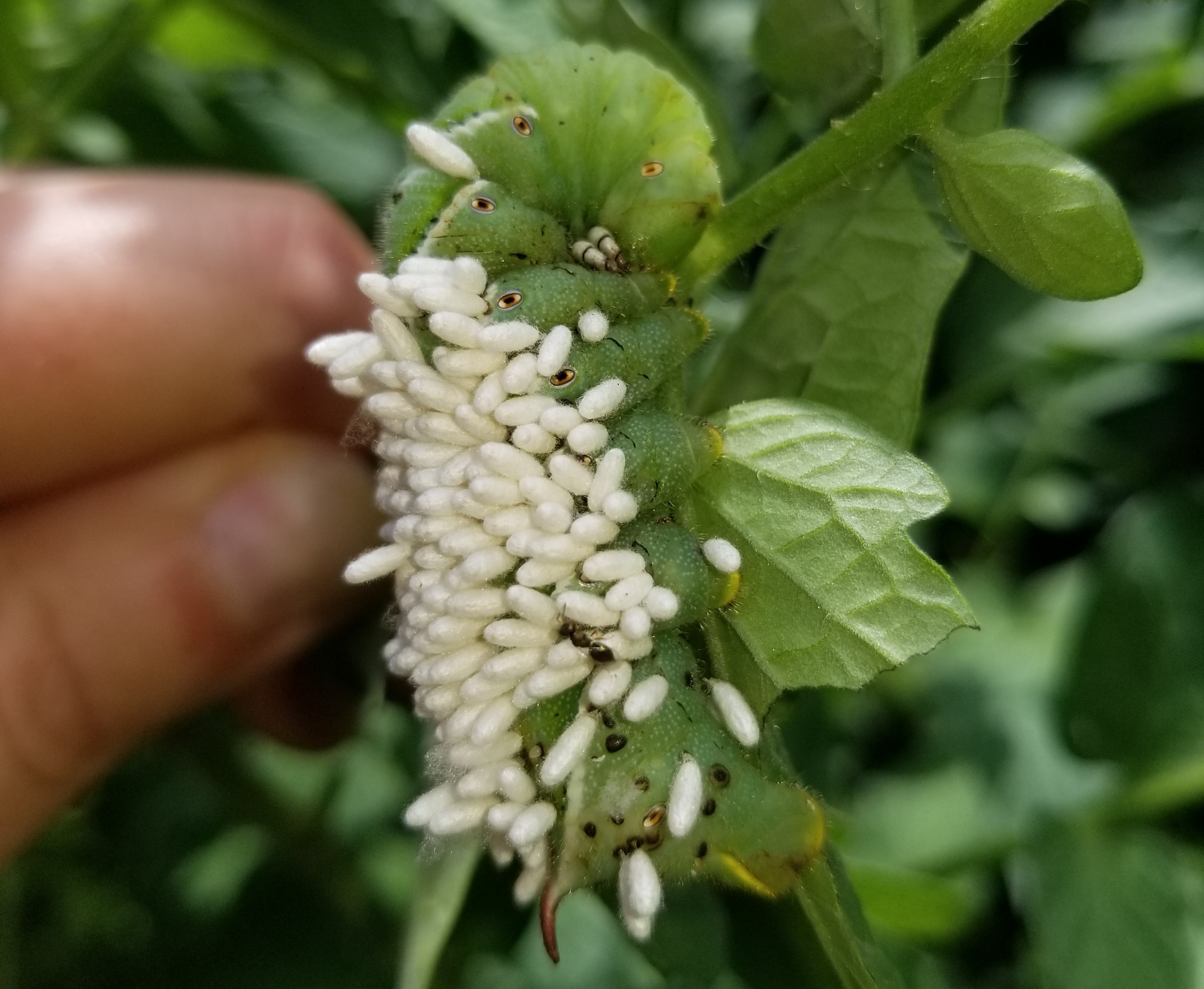
Today in my garden while watering, I came across this big guy attached to the underside of a leaf near the top of one of my tomato plants. I had never seen this creature before. I thought it could be a monarch butterfly caterpillar, but it seemed too big and not stripey enough. I posted a photo on my Facebook page asking if anyone could identify it. The next morning there was unanimous consensus that it was a green hormworm caterpillar and I needed to get rid of it immediately. Not only that but, that this little guy and his friends could wipe out my tomato plants quickly if I did not get rid of them.
One friend through experience said that I should check my tomatoes twice a day and kill these critters by hand. She had just dealt with the same in her tomatoes and warned that they would quickly strip my plants bare. She said to look at the top of the plants under the leaves – which describes exactly where I found my guy. She kept at her twice a day worm search for a week until she was satisfied that they were all gone.
Another friend concurred saying that one hornworm stripped her tomato plant in one afternoon! She suggested putting white poster board under the plants because the worm poop will be easily seen. Green hornworm caterpillar poop looks like the lead of a pencil. She said if you see the poop that means the worms are still there. If you want to more polite about it, we can call it insect frass, according to some of the other websites I searched.
A third friend said that they are easy to find by following the path of destruction. Simply look for the eaten damaged leaves and there will be sure to be a green hornworm close by. I decided that this was the easiest way to start, so I went out to survey the damage, expecting the worst and worrying that it would be hard to find my guy in the viney tomato jungle.
At first look, I could see no eaten leaves. Upon close inspection, some of the leaves were withering but definitely not eaten. I went to the spot where I had seen my green hornworm caterpillar and found him to be sitting just about where he had been the day before. Not only that, but I could not see any sign that he was destroying my plants! Why the good fortune? There is more this story.
See those white pill shaped things all over? Those are not part of the caterpillar, those are wasp eggs. I am not sure which kind of wasp; I see quite a few different species of wasp in my yard. The wasp eggs are actually good news for me. Bad news for the caterpillar. The wasp eggs are a parasite and are feeding on the caterpillar and they will eventually kill it. So after reading more about it, because the wasp eggs are present, the recommendation is to leave the caterpillar so that the natural predator of the green hornworm caterpillar be allowed to feed and hatch.
After carefully assessing the rest of my tomato plants and being pretty sure that there were no other worms. I took the one green hornworm caterpillar from my big beautiful tomato plant and moved him to another volunteer over to the side of my garden in case he started to feel hungry. The following day, I went out again to check on him and he had hardly moved. His top appendages (arms?) were not even holding on to the stem and he seemed paralyzed. I believe the wasps were feeding on him and he would not be around much longer.
Named for the horn at the end of the larval body, there are actually two types of green hornworm caterpillars: the tobacco hornworm and the tomato hornworm, obviously we are dealing with the latter. The green hornworm can complete two life cycles per year between May through October. The eggs are very small (0.05 inch) with a light green to white color and are deposited on the underside of leaves. The egg stage averages five days. There are five larval instar stages which average 20 days during which the hornworm grows larger during each successive stage to a final length of up to 3.2 inches long. At the last instar the larva develops to a pupa, dropping to the soil to burrow and form a pupa cell. The moth that develops from the pupa stage has a wingspan of nearly four inches. The complete life cycle of the green hornworm is between 30 to 50 days.*
Besides tomatoes, they also have an appetite for peppers, eggplant, and potatoes. It is really too bad that the green hornworm caterpillar is such a garden pest because it turns into quite a lovely moth. The moth is a type of hummingbird moth and like hummingbirds they are pollinators and can hover over flowers to drink nectar with their long tongues. They may also be called Sphinx moths or Hawk moths.
* Source of life cycle information: http://entomology.ifas.ufl.edu/creatures/field/hornworm.htm