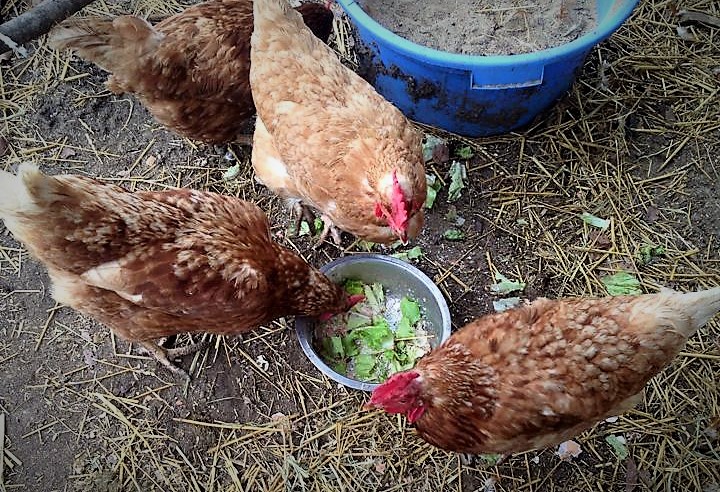
I live in the city and I want chickens. Not for dinner, but in my backyard. I live in a small mid-western city that does not allow the backyard birds. I am hoping to change this soon. I have oodles of friends who live outside the city limits and are enjoying their feathered friends. Not only do the chickens produce eggs, and take care of garden pests, but they also become a part of the family. They are given names and one friend even knits sweaters for her hens!
My city just recently reversed a ban on backyard beekeeping, so I have reason to hope. I am starting with an email to one of my city council members. The email begins with an inquiry to find out if anyone else has recently requested that the city allow chickens. My case primarily centers around the benefits in support of urban agriculture as a whole. I give examples of other cities that allow chickens. I state limitations that these cities have placed on having chickens. Finally, I request that our city change its rules to allow backyard chickens.
The email:
Dear Councilwoman,
I am writing to inquire whether the city has recently considered or been requested to consider allowing residents to keep chickens. I know that the city reversed its rules to allow backyard beekeeping and I commend the city for doing so. It has become the new standard to allow beekeeping in cities throughout the United States. I would even love to see Peoria become certified as a BeeCityUSA. Small scale agriculture is so important for a number of reasons:
1. Food Security – Provides high quality food which is very cheap to produce. In the U.S., poverty leaves families without enough food to have three meals a day. School-aged children are fortunate to have free lunch programs during the school year, but their families may still not be able to provide enough food for hungry growing children. Sometimes parents go without so that their children have enough. Growing food allows food insecure families to produce food to supplement their meager pantries with high quality healthy food.
2. Economic Benefits – Eating food grown locally means fresher lower cost for healthy food. As small grocers have been squeezed out by fewer larger grocery chains, urban areas develop so called food deserts where people have to travel an unusually far distance to find food. In low income areas where people may not have reliable transportation, traveling to a grocery store that has produce can be a huge hurdle to eating health. Fresh grown food give people a way to produce healthy food which is cheap without having to travel. Even for low income people who can travel to grocery stores, fresh produce is usually an expensive luxury.
3. Social Benefits – It connects people to the earth when they grow their own food. Children can learn first hand how vegetables grow and see the various stages from seedling to the final edible product. Actively engaging youth in urban agriculture is a positive alternative to avoid other less productive and even harmful activities, ranging from watching too much TV to becoming involved in gangs. For older residents, urban agriculture can become a hobby that instills pride and enjoyment in life.
4. Rural Ecology – The environment is improved through urban agriculture as the ecosystem benefits through increased numbers of plants, animals, and insects thriving and contributing to a rural ecology. A city void of nature becomes a harsh concrete jungle. Hot temperatures contribute to death among the elderly and increased violence. Urban ecology can even lower inner city temperatures during hot summers. Additionally, raising food locally cuts down on carbon emissions from transporting food from all over the country to the grocery stores.
Gardening allows residents to grow highly nutritious vegetables and fruits. Beekeeping gives people a much healthier alternative to sugar while supporting pollinators which is so important to the environment. If city residents were able to keep backyard chickens, they would benefit by having a great source of protein for very low cost. For families who struggle to put food on the table having fresh eggs is a wonderful source of protein for growing children who would otherwise be food insecure.
Many cities across the country have recently allowed inner city chicken coops: Ann Arbor, MI, Ft. Collins, CO, and Portland, ME. Cities in Illinois that allow backyard chickens include Chicago, St Charles, Naperville, Downers Grove and Oak Park. The city of Chicago allows hens for egg laying, but restricts hens raised for slaughter. In Chicago you can own any kind of livestock – chicken, goats, pigs, bees – as long as you do not intend to raise it in order to kill it for food. So, you can own goats for milk, pigs as pets and bees for honey. There are no restrictions on how many you can own or what type of housing you need to provide, however you must also be in compliance with other ordinances, such as public nuisance ordinances, think smells and noises. In addition, any structures you build must be in compliance with building codes and permits. Further, there is a restriction on bird keeping facilities as a home occupation.
Generally ordinances for keeping chickens in urban areas do not allow roosters because they are a nuisance and have a limit to the number of hens that can be kept. Similar to my city’s recent city beehive ordinance, chicken coops may also have restrictions for size, placement and distance from property lines. Please consider allowing chickens to be kept within the city. The benefits are numerous and will align our city with other progressive cities across the country.
Respectfully,
Kate
Keeping my fingers crossed. I will update when I get a response.