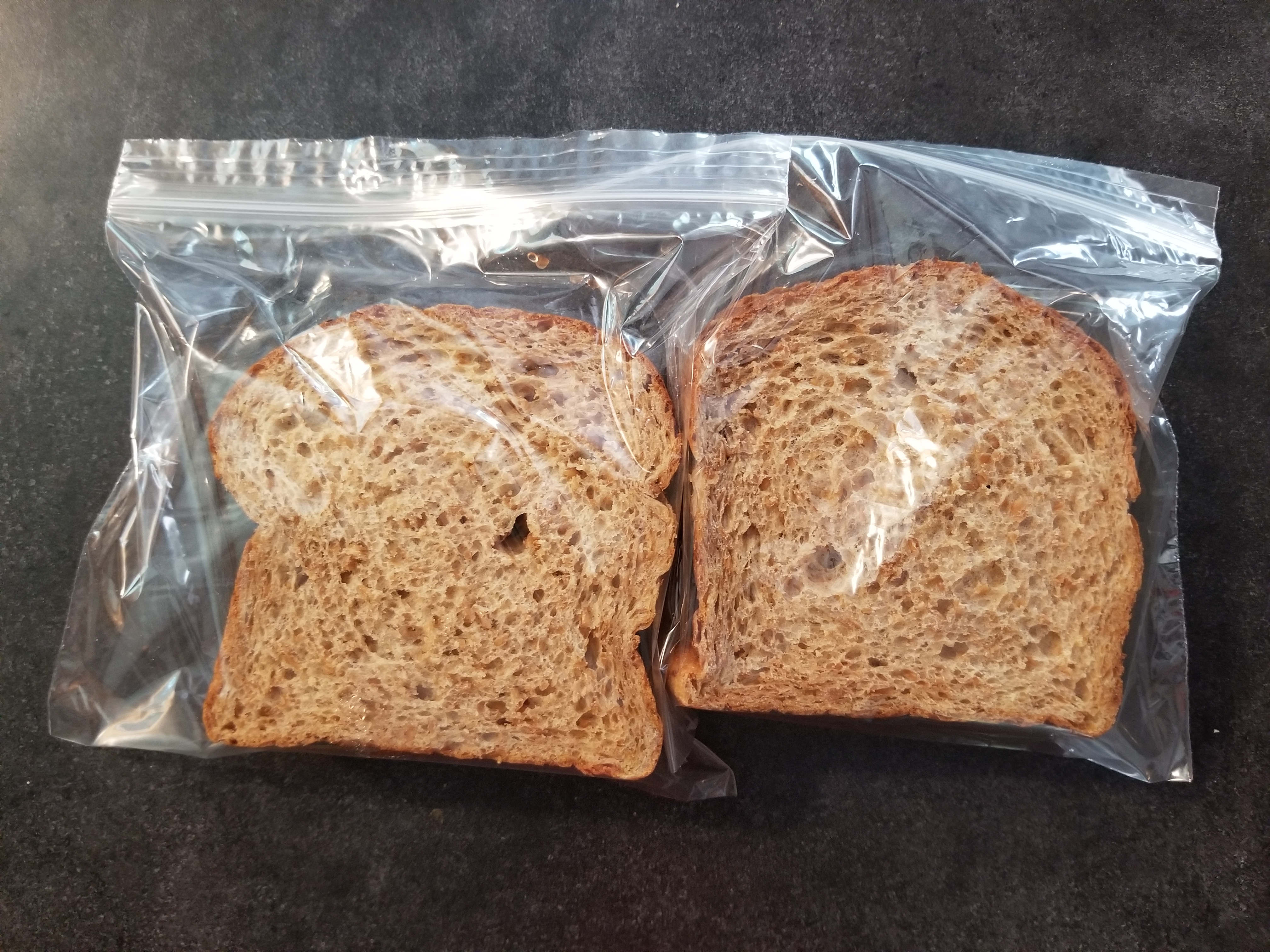
Packing lunch is usually healthier than buying lunch in a cafeteria, restaurant, sandwich shop, or a fast food joint. And bringing lunch from home is almost always cheaper. But it is not always greener. Convenience is king when racing around in the morning and trying to get yourself and the family out the door. The plastic sandwich baggie is so convenient. They are cheap and slim. They keep the mess inside and can even contain all the other lunch garbage into one waste packet; stuff the dirty napkins and banana peel inside, zip it up, and throw it away. Think no more of it until the next morning.
I am not perfect. Remember I am on a journey to do better! My confession: I am guilty of using plastic sandwich baggies. They are especially great for containing a PB&J for kids eating in the car on the run. For a family of four who packs sandwiches, chips, carrots and cookies, this can mean 16 fewer washable containers in the sink at night. And heaven forbid anyone forget to take the containers out of their lunch bag and have to deal with smelly warm food leftovers. So there is the ick factor as well. Plastic baggies reduce the ick factor big time.
It sounds like I am rooting for the plastic baggie. Let’s see, convenient, cheap, fewer dishes, less ick…it is true, they have many great qualities. Except that they are disposable and create a lot of waste which takes a long long time to decompose in a landfill. Plastic baggies cause major problems when animals encounter them in their habitats, especially in freshwater or saltwater environments.
This year I am committing to ditch the plastic sandwich baggies for good. Even though we may have to rinse and load 16 additional containers into the dishwasher at night, we will save about 1,000 plastic baggies from going into the landfill each year by using washable reusable containers. Since the first day of school is right around the corner, I just stocked up on reusable sandwich sized containers and smaller snack containers for my kids to take to school.
There are a number of alternatives for taking lunches without creating unnecessary waste that will go into the landfill. Here are some of the alternatives:
- Plastic containers – Tupperware and Rubbermaid are probably the most well known brands of plastic storage. This is what we use mostly in our house. Most of our containers are the cheapo ones that we picked up at the grocery store out of convenience and low price. Sturdier plastic containers generally last longer, but cost more initially. We have also accumulated a few from purchasing lunch meat that comes packaged in a plastic container. One plus for plastic reusables is that they are great for kids. For one, they are light weight. Many have latching mechanisms that are easy for little hands. And they do not pose a dangerous risk if dropped, as opposed to glass containers. I know plastic is not the best health-wise, but I do not plan to replace them until they crack. Once they have outlived their usefulness, the containers are recyclable. As my kids get older and I need to replace my food storage containers, I do plan to invest in something other than plastic.
- Glass containers – Rubbermaid, Pyrex, and Anchor seem to be the leaders in glass food storage containers. Most glass food containers have plastic lids, but the glass is the only material in contact with food. Glass containers are a safer bet for reheating food in the microwave than plastic. One downside to glass is that it is heavy to carry in a lunch bag. Another downside is that it is breakable which poses a risk to kids especially. When a glass container breaks, it may need to be disposed of as trash, not recycling unfortunately. Our recycling hauler prohibits broken glass in our recycling.
- Metal containers – Metal food containers are newer as a food storage option. In response to BPA found in plastic years back, quite a few metal stainless steel containers came on to the market. The first ones I saw were in the form of bento boxes for kids’ lunches. Metal tends to be heavier than plastic, but it is nearly impossible to break. Some metal storage containers even have metal lids, while others have plastic lids. Because metal containers are unlikely to ever break, they will just about last forever. If there ever was a reason to dispose of a metal container, it would be recyclable. One downside to metal containers is that you can not see what is in them unless you open the lid. I personally like to see what is sitting in my fridge without opening each container. But for lunch containers this would be a great solution.
- Mason jars – I considered lumping Mason jars in with glass containers, but I feel that they are in a category of their own. Typically used for canning since 1858 (according to wikipedia.com), the Mason jar was the first screw top lid on a glass jar. Previous to the iconic Mason jar, canning in glass had only been around since the turn of the 18th century. Before the patented Mason screw top lid, lids were made of wax, glass and metal wire. Recently, Mason jars seem to have become popular as storage for food, not just for canning purposes. Mason jars are great for taking soups and salads to work. I have even seen Mason jars used for drinking glasses in kitsch restaurants.
- Silicone baggies – Silicone seems to be gaining in popularity for a number of kitchen uses. There are formed silicone containers similar to plastic food storage containers. And now, I have just recently found silicone baggies! This is very exciting. Silicone baggies may be the key to my breakup with plastic sandwich baggies for good. No rebounding! I have some sitting in my Amazon.com cart as I type. One huge benefit to silicon containers and baggies it that they are collapsible and require much less storage space than plastic, glass, or metal containers. They can also be washed in the dishwasher, which is a huge plus for me. While being most similar to plastic sandwich baggies, silicone baggies have the benefit of being able to withstand very cold temps (-58℉) and very hot temps (482℉). Silicone is very durable and does not breakdown, however it is not impervious to being cut. When I googled, it does say that silicone is recyclable, but I am not sure if silicone recycling is common. Check with your local recycling center.
- Cloth & plastic baggies – There are a number of options for using cloth and plastic baggies to replace disposable plastic sandwich baggies. If you opt for cloth without a plastic coating, then you will be limited to storing dry foods, such as chips and cookies. If you opt for plastic coated baggies, depending on how they are made, you may be able to store wetter food items as well, think fruits and vegetables. There are also some baggies made out of a more durable reusable plastic without the cloth; these are typically transparent. Most cloth baggies have very stylish patterns. Closures are either zippers, Velcro, or drawstring. The downside of these bags is that most are not dishwasher safe and must either be hand-washed or laundered. The plus is that if you can sew, you can make these yourself!
- Waxed paper – If you are looking for something in between reusable and disposable, compostable is another option. Good old fashioned waxed paper. You can buy waxed paper in sheets or bags. There are varying thicknesses available. It is not going to be good for liquid tight storage, but will work just fine for sandwiches, chips, cookies, and even vegetables. Lay flat and wrap your food as you would a present, hold together with masking tape. Parchment paper may work too, but do not confuse waxed paper with freezer paper. Freezer paper has a plastic coating on one side which is not compostable. You may think that using waxed paper is a cop-out, but understand that waxed paper will biodegrade in about one month, whereas a plastic sandwich baggie can take 20 to 1,000 years! If you want to be greener without the added dishes, this is a great alternative.
- Aluminum Foil – Another oldie, but goodie. Aluminum foil can be used to wrap food for lunches and is still a better option than the plastic sandwich baggie because the aluminum foil can be recycled.
As you can see there are a lot of alternatives to using the plastic sandwich baggie. Some of us just do not have the time to wash the extra containers and waxed paper may be the best. Others may be trying to live a completely plastic free life and metal is the way to go. Whichever you choose, any of these options is better than the plastic sandwich baggie, so DITCH IT! I am.