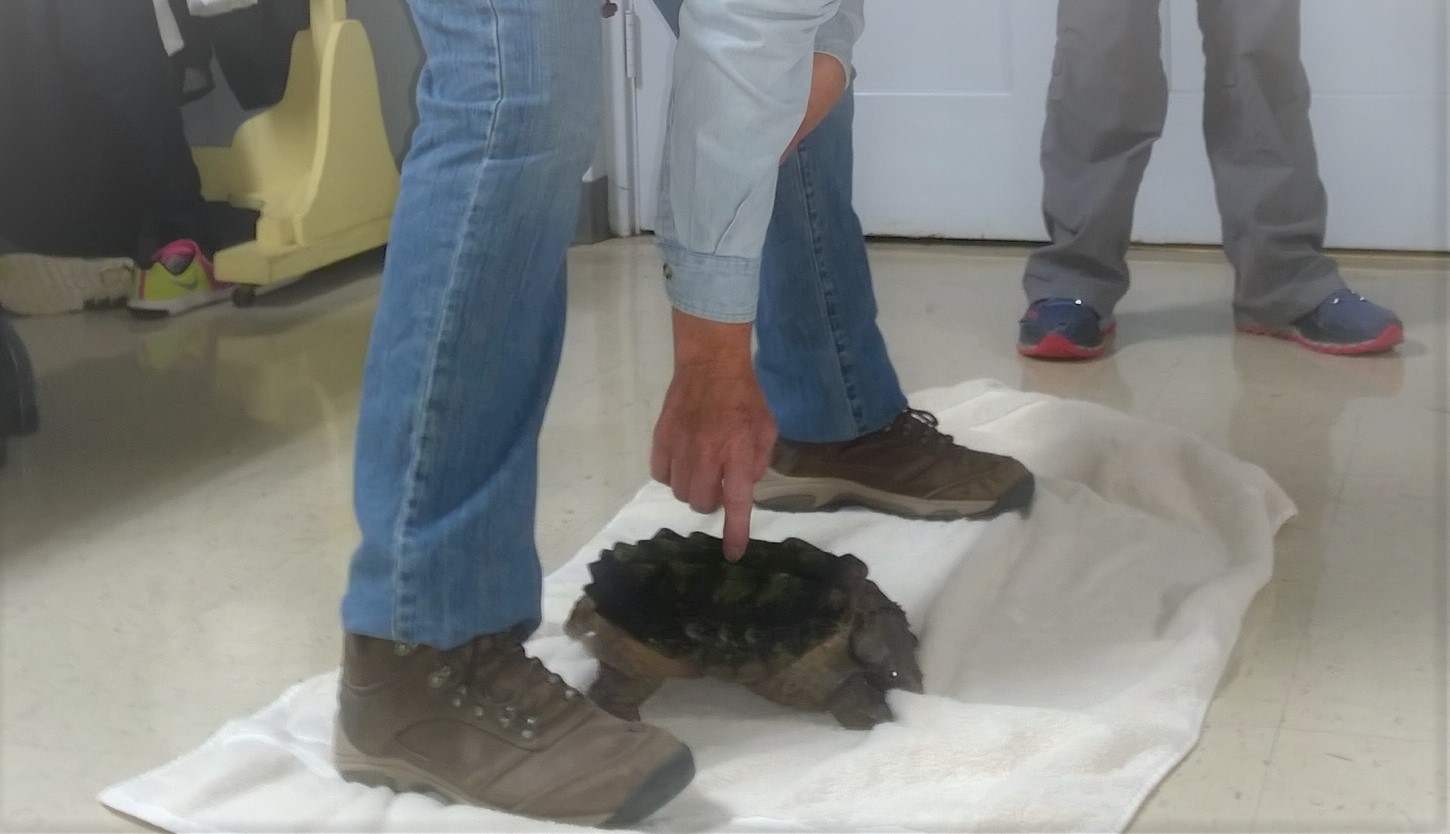
Last winter my girl scout troops had a visit from the local wildlife rescue, an event held during a half day off school in the basement of a neighborhood church. The two women from the wildlife rescue brought an impressive assortment of animals to show the girls, who range from second grade to fifth grade. There was a frog, a toad, a snake, a skunk, a barn owl, and an alligator snapping turtle. The alligator snapping turtle, they explained, is an endangered species in Illinois and a threatened species in the United States. No one was allowed to get too close for fear of a quick chomp! They explained to the girls that the Department of Natural Resources releases snapping turtles into the wild each spring to re-establish the population in Illinois.
This spring I had a pleasantly unexpected encounter with the alligator snapping turtle myself. If it had not been for the girl scout event I probably would not have realized the significance of it. I live in the city, but my property backs on to a huge cemetery that also happens to be bordered on the north and south with two huge parks which form part of a contiguous system of woodlands along the Illinois River bluff for many miles. To have this bounty of nature in my backyard is a gift; much of Illinois is flat farmland for corn and soybeans. Nightly, I hear the barred owls hooting “who cooks for you” starting around 4:00 PM in the summertime. Just beyond my backyard, the cemetery property is woods, ravines, and creeks for at least half a mile; I can not see any graves from my backyard. It is the one of the oldest cemeteries in Illinois. Besides its primary purpose as a final resting place, it is enjoyed by the community as a park for walking, biking, and running. There is a midnight marathon in the cemetery around Halloween each year. And my personal favorite, the historical cemetery tours are a series of monologues by local actors reenacting the part of past local residents now buried in the cemetery. It is a thoroughly enjoyable and educational event. But back to the turtles…

Can you see it? There is an alligator snapping turtle (circled in yellow) in the creek behind my house – very hard to see in this photo.
I often walk with my dog in the cemetery. I get my fill of nature, most commonly seeing deer, coyote, and turkey. Occasionally, I spot an eagle flying above me. One day this spring, I stopped to look at the creek and I spotted a turtle. I do not recall ever seeing a turtle in the creek before. The photo I took is a little grainy because I was standing on a bridge zooming in to get a closer look. But I do believe it was an alligator snapping turtle. The shell of the turtle looks ridged and horny, not smooth like the common snapping turtle. Also in my research, the alligator snapping turtle lives in slow moving rivers and creeks like the one in the cemetery. Whereas the common snapping turtle prefers ponds and lakes. They are the largest freshwater turtle in North America with males reaching up to 31 inches in carapace (shell) length and a weight of up to 200 lbs. They have large heads, hooked beaks, long tails and a worm-like tongue, used as a lure to attract prey. Alligator snapping turtles can live up to 200 years! The one I saw had about a seven inch carapace which would be about a ten year old turtle.
As a protected species in Illinois, it is illegal to possess, capture or take an alligator snapping turtle. The turtle spends most of its time in the deep water and mud of slow moving rivers. They are most active at night and prefer to move by walking rather than swimming. Female turtles lay their eggs along the banks of rivers. Sexual maturity in the species occurs between ages eleven and thirteen. Courtship happens in late spring, and ten to sixty eggs are laid in late May or early June. Eggs hatch in 90 days. The alligator snapping turtle rarely leaves the water to bask in the sun as other turtles often do. However, the females leave the water to find a place to lay eggs. So if you see an alligator snapping turtle out of the water DO NOT DISTURB, it is probably a female laying eggs. If you disturb her, you may cause her to not lay her eggs and even to die because of the unlaid eggs in her body which need to come out.

Here is a close up of the turtle in the creek – still grainy but definitely looks like an alligator snapping turtle!
So what is going on with the alligator snapping turtle in Illinois? Why is it a threatened species? Changes and alterations to major waterways, which are the habitat and breeding ground for the turtles, created barriers to the natural turtle migration. Removal of log jams disturbs places for turtles to hide and hunt for food. At one time smaller alligator snapping turtle hatchlings were caught and sold as pets and the larger turtles were captured for meat. Over time, the collection and over-harvesting of the species eliminated the turtles from certain areas. By the 1960’s, alligator snapping turtles were extremely rare in Illinois. The major waterways associated with the Illinois population of the turtles are the Gulf of Mexico drainages of the United States: the Mississippi River, the Illinois River, the Ohio River, and the Wabash River. Historically, all of these rivers were primary habitat to the alligator snapping turtle.
The effort to bring back the turtle to this region is funded through a multi-state competitive State Wildlife Grant by the U.S. Fish and Wildlife Service to Illinois, Oklahoma, and Louisiana. The grant covers long term monitoring and tracking of the released turtles. The turtles that were released in Illinois this spring were raise by the Tishomingo National Fish Hatchery in Oklahoma and paid for by the Illinois Wildlife Preservation Fund. Ninety-seven turtles were released in Illinois. The Illinois Natural History Survey recorded data for each turtle and affixed the transmitters and iButton dataloggers. The Illinois Department of Natural Resources and the Illinois Natural History Survey worked with a number of local organizations including our local zoo. The local zoo is just to the south of the cemetery creek where I saw the alligator snapping turtle. I wonder if he (or she) was one of the ninety-seven that was released? I did not get close enough – as you can see from my grainy pictures – to see if there was any transmitting or datalogging devices attached. Believe me, I wanted to get a closer picture, but the poison ivy made that nearly impossible, especially while walking the dog. Hopefully this is the first of many alligator snapping turtles I will see during my walks.
All information about the alligator snapping turtle was found on the Illinois Department of Natural Resources website. Enjoy this video by the IDNR for more information about the release this past spring.