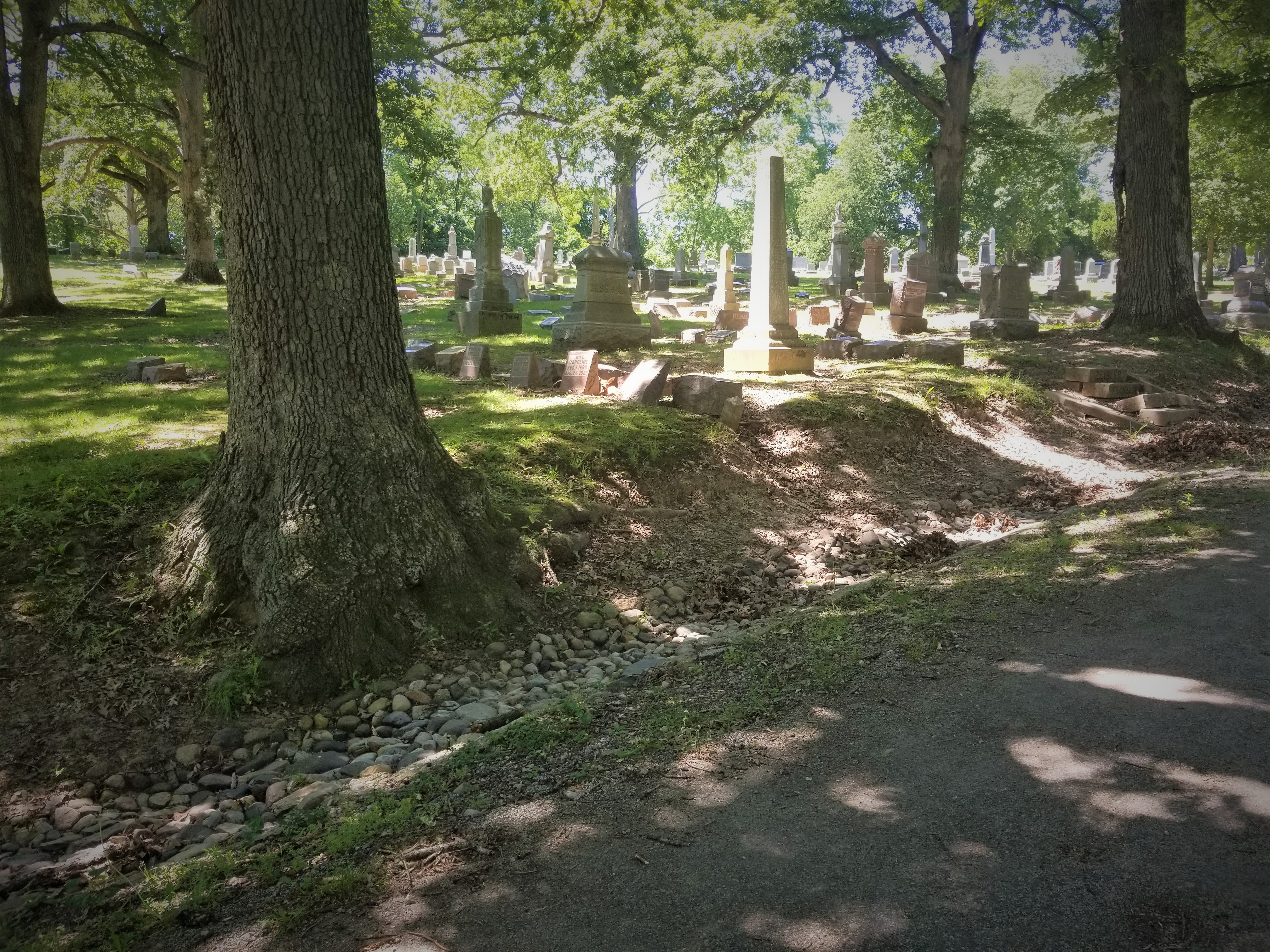
Can you spot the fawn? While walking in a cemetery, one does not expect to see a brand new life, recently born. On a lovely June day, my two daughters and I were taking a walk with the dog during the first week of summer vacation. I almost missed it. The girls and I were chatting and the dog never did see or smell it. If it had not been for the shining sun reflecting on the wet nose of the fawn, placed in care between two rows of headstones, I probably would have walked past without noticing.
I have seen pictures of fawns hiding out after birth, but I had never seen one myself in real life. I can not explain to you how precious it was. The photos do not do the experience justice. To see a babe of nature, alone, big brown eyes, wet black nose, the amber fur sprinkled with white spots, my human motherly instinct wanted to grab up this creature and care for it like my own. Or at the very least just pet it! However, I am an educated person and I resisted the temptation. I know that mother does do not abandon their fawns. This is part of their motherly instincts and I respected that, of course.

See the fawn nestled in between the headstones?
A doe generally isolates herself from the herd to birth, usually laying down to do so. Fawns are either born singly or as twins, each taking fifteen minutes to half an hour to be born. Triplets are possible but rare. Before moving her babies, the mother will clean her young of the amniotic fluid and membranes. She will also consume the afterbirth including the placenta and any blood stained leaves and vegetation. Consuming and cleaning all traces of the birth clears the area of the scent that might attract predators and also gives the mother needed nutrients and energy after birth.
Fawns begin nursing immediately after birth to drink the colostrum rich milk. A fawn can walk twenty minutes after birth and the mother moves her babies within three hours of giving birth. Twin fawns are moved to separate locations. After birth, fawns spend their first few weeks alone under cover and motionless to avoid predation. In other words, a wobbly baby deer is easy prey for a hungry predator. It is better for the fawn to stay hidden by itself than to be unable to keep up with its herd. Although they can walk shortly after birth fawns spend 90 percent of the first few weeks bedded. In May and June, 80 percent of the fawns for the year are born and in hiding on the ground.

Here is the fawn from another angle.
A mother doe does not spend much time with her fawns in these first few weeks. Although you can not see her, she is nearby. A doe is usually about 100 yards from her fawns. Fawns nurse two to three times per day as newborns, increasing to six to eight times as they get older, usually only feeding at dawn and dusk. When fawns are found alone in strange places, many people assume incorrectly that they are orphaned. Unless the fawn has been placed in a dangerous location, leave the fawn be. People may need to change your habits to avoid bothering the fawn. For example, if I had a fawn in my backyard, I would not let my dog out back until the fawn had moved along. Mama isalways watching. Another good reason not to feed, pet, or take a fawn is that does can be very protective of their young.
It is illegal to keep a fawn without a permit in Illinois. Even if people know not to pet or keep the fawn, when well intentioned people see a scrawny little fawn, they may think feeding it is a good idea. Teaching deer to associate humans with food is dangerous to the deer. It is a disservice to teach a deer to approach humans. Remember that humans hunt deer. Furthermore, a deer that has no fear of humans may become a nuisance and even aggressive and may need to be euthanized. Even if you do not see the mother, rest assured that she is feeding her babies at dawn and dusk. At three weeks old, fawns start to eat vegetation. They are also reunited with their twin at this time. At three weeks of age, they can outrun most predators.
The fawn that I came across was not in anyone’s way. Hopefully the mother moved her fawn before the groundskeepers came to mow the grass and trim the weeds. I am curious to know how old the fawn was. I suppose it could have even been born that very day. I did see a doe earlier on my walk and after I spotted the fawn, I was pretty sure that she was the mother. I remember thinking it was odd when I saw the doe for two reasons. One is because of the time of day. I usually only see deer at dusk, (I probably would see them at dawn too if I were a morning person!) however this doe was out at 1:00 in the afternoon. Also, I usually see deer in small or large groups, but this doe was alone.
Here is a video I found on YouTube of twin fawns being born. I would love to see this in my woods and capture it on video!
Doe gives birth to two fawns right outside our window Published on Jun 21, 2016 by jenalynnkessem
Information about whitetail deer birth and early life found on the University of Illinois Extension, www.outdoorlife.com and www.tinks.com