My husband is forever the reluctant environmentalist. I wanted to put rain barrels in for years. For every hair-brained idea I come up with, Jake thinks that for all of the effort to be crunchy granola, it will be a hassle and cost more money. He may be right about the hassle, but not the money. Especially when you take advantage of an opportunity to get materials for free. Remember that one of the three R’s is REUSE! (You know, as in the environmental trifecta: reduce, reuse, recycle.)
For my job as an environmental consultant, back in 2014, I was working on the environmental management of a demolition project. The three old brick and steel buildings slated for demo were built in 1911. For over 100 years, the buildings housed the manufacturing operations of heavy equipment. Throughout the years the buildings had been used for a number of purposes: assembly line, welding, chrome plating, research and development testing, storage, etc. As newer buildings were built to replace the old ones, the buildings were increasingly used for storage. The last user was R&D, once they moved into their newly built building, the old brick buildings were planned to come down.
Anything that could not be recycled was going down with the buildings and ultimately to the landfill. Many workers jumped at the chance to take old relics from the 100 year old buildings. One very nice 1960’s era hardwood conference room table was snatched up immediately. While unnoticed in the corner, a big deionized water system which had not been used for years was hidden back by the restrooms. The two large fiberglass tanks which had been used to store the DI water were there, sitting empty. I had need to go back in that area each month for inspections, so I knew they were there and asked if I could have them. No one else wanted them and they were all mine.

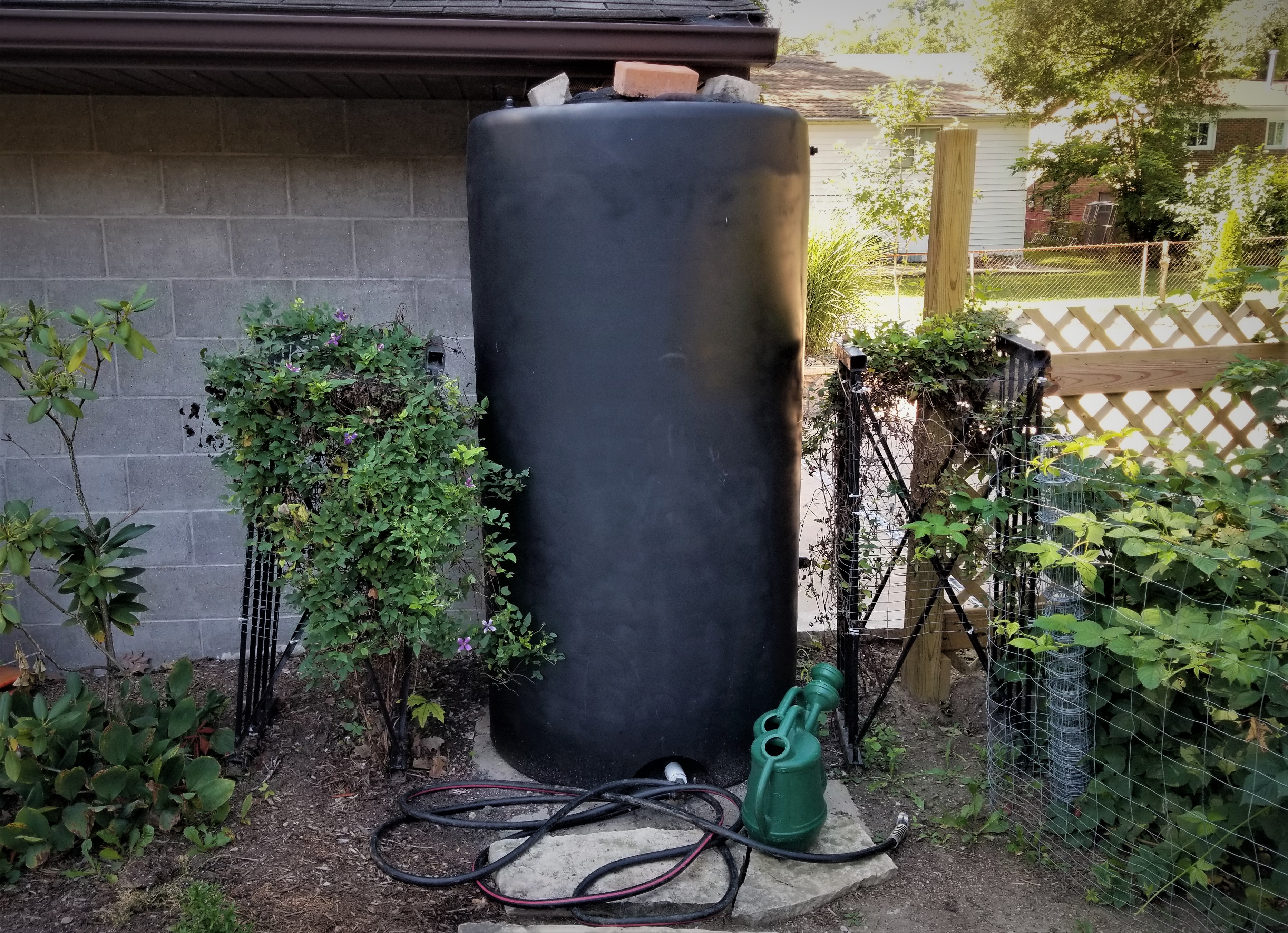
The larger of the two rain barrels sits on the southeast corner of the garage. This barrel has a 500-gallon capacity.
To me these were golden! Most tanks around a manufacturing facility would not be suitable for salvage. Generally, they would have been used for antifreeze, oil, diesel, or waste liquids, but not these tanks. They were untouched by anything but water. And not just any water, super pure clean water that was used for R&D testing. The fiberglass tanks were two different sizes: one was a 500 gallon tank and the other was a 300 gallon tank. I borrowed my husband’s work truck, an F-350, to haul the tanks home.
My mother-in-law got rain barrels a few years before we did. This was probably part of Jake’s lack of excitement over me bringing these tanks home. He installed his mom’s rain barrels and was often problem shooting when she called saying it was full but nothing is coming out, or it is overflowing because there is too much rain and the barrel is full. Her rain barrel is more typical for what you see installed at a person’s home, a 55-gallon blue plastic drum. I can not remember if she got it for free or if she paid for it as a new drum. But I do know that 55-gallons does not get you very far when it comes to watering plants. If you had a crystal ball and knew when it was going to rain next, it would be easy to manage. During the long dry spells, she always runs out.
When it comes to rain barrels bigger is better. You see, the thing about rain barrels is that they are full just after it rains, when you do not need them, and empty when you really need them, after a long period without rain. So the more water you can collect the longer it will last between rains. In the mid-west, it rains fairly often throughout the year. The average precipitation per month is just over 2 inches in the winter and not quite five inches in the spring and summer. The average rainfall per year in our part of the world is 40 inches.
At the end of May and early June this year, we had an 18 day stretch without rain. Our rain barrels get pretty low when we go that long without. Much longer than that would be a serious drought for the region and we might run out of rain water, but this does not happen very often. After the three week dry spell, we made up for it with 1.6 inches of rain over 10 days.

The 500-gallon barrel sits in the vegetable garden on the back side of the garage.
So how much water can you collect during a rain? It depends on the size of your roof, the amount of rain, and the capacity of your rain barrel. Our rain barrels collect water from our detached garage; one on each side. The garage is 20 feet wide by 30 feet long. I do not know the exact pitch of the roof, but let us just assume that it is a 30 degree angle. Using our 30-60-90 triangle formula (dust off those brain cells) the hypotenuse of the triangle is 11.5 feet; this is the width of one side of the roof. Each rain barrel is fed from one side of the garage roof which has an area of 11.5 feet wide by 30 feet long, or 354 square feet.
Here is a cool rain barrel calculator to calculate the amount of water you can collect in your barrel. When we get one inch of rain, we collect 216 gallons of water in each rain barrel, for a total of 432 for both barrels combined. As you can see, we have the capacity of 300 and 500 gallons in our barrels, so we can collect every drop. If your rain barrel is only 55 gallons, you are not reaching your full rain collecting capacity. For the entire year in the mid-west, we average 40 inches of rain. If we collect all of this in our barrels throughout the year, we will have collected 17,250 gallons of water! Water in the mid-west is cheap at $.585 per 100 gallons. For our efforts, this saves us just over $100 per year in water costs. Generally our monthly water bill is around $50 per month, so by collecting rain water we are saving 14% on our annual water costs. Not too shabby for a couple of freebies!
Information about this year’s rain fall was obtained from www.wunderground.com/history/ You can search the rainfall history for your location!